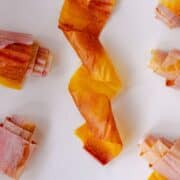
How to Make Fruit Roll Ups
Delicious and wholesome fruit rolls ups! The ultimate fun treat that's made with just fruit. I love making these as a strawberry mango swirl fruit roll ups!
Servings: 25 fruit roll ups
Equipment
- 1 blender
- 2 baking pans or 2-4 dehydrator pans
- parchment paper or a silicone mat
- spatula
Ingredients
- 4 mangoes large
- 1 ½ tablespoons lemon juice
- 2 cups strawberries
Optional
- 2 tablespoons chia seeds
Instructions
- Peel the mangoes and cut the fruit away from the pits. Place the mango flesh and lemon juice in a blender and blend until completely smooth. Line 2 large baking sheets or 4 dehydrator trays with parchment paper or silicone mats. Pour the 1-2 cups of mango puree onto the prepared trays and spread into a thin, even layer, making sure there are no bare patches (save some of the mango puree in the blender).
- Remove the stems from the strawberries. Then with about 1 cup of mango puree left in the blender, add the strawberries and blend until the mixture is smooth and thin. Pour the pink strawberry mixture onto the trays in lines beside or over the mango puree. Sprinkle the chia seeds on top of the puree fruit if using. Use a spoon or skewer to gently swirl the mixtures together for a swirl effect.
- For the dehydrator method, dry at 115°F for about 5-8 hours. For the oven method, bake at the lowest temperature setting, about 170°F, for approximately 6 hours. The fruit leather is ready when it feels dry and even spongy to the touch. It will peel away easily without sticking.
- Roll the parchment paper and fruit leather into a log and then cut into about 1.5-2 inch chunks. Keep them in an air tight bag or container and they will last for months.
Something you can do is pour the puree in two long yellow strips across the tray, and then two pink strawberry stripes beside which makes it look cool later.
The total time will depend on how thick the fruit is spread and if you have a fan in your oven or dehydrator.
Notes
How long does fruit leather last? I have fed my kids fruit leather for months. The key is to make sure there are no wet spots after dehydrating it because that's what will go bad.
To store them for an extended time, add a paper towel into the bag or container you keep the fruit leather in to absorb the moisture.
If your fruit leather became too crispy or over-dried in some areas, you can sprinkle or spray it with water to rehydrate the leather and make it softer! Often, you will need to do this on the edges.
Other flavors: I've made watermelon fruit roll-ups by blending watermelon and draining out all the liquid with a cheesecloth. You get a small amount of thick watermelon fruit at the end and a ton of watermelon juice. I dehydrate the 'watermelon pulp' on a sheet, and I put the true lime powder on it to make it a sour watermelon fruit roll-up.
I've made peach apple chia fruit leather just by blending the fruit until smooth. I don't always remove the peels before blending. Then I sprinkle the chia seeds on top, once the fruit is spread on the pan.
Rhubarb is the only fruit I've cooked prior to using; here's my recipe for rhubarb fruit roll-ups.
Nutrition
Serving: 1fruit roll up | Calories: 24kcal | Carbohydrates: 6g | Protein: 0.4g | Fat: 0.2g | Saturated Fat: 0.03g | Polyunsaturated Fat: 0.04g | Monounsaturated Fat: 0.1g | Sodium: 0.5mg | Potassium: 74mg | Fiber: 1g | Sugar: 5g | Vitamin A: 360IU | Vitamin C: 19mg | Calcium: 6mg | Iron: 0.1mg